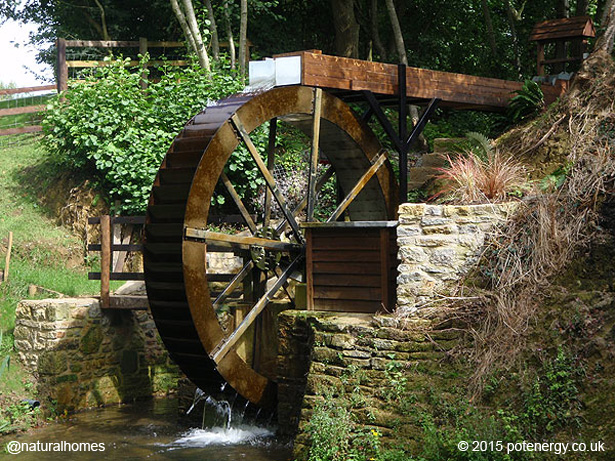
Hydro power: Harnessing the energy of water.


Basics in micro-hydro

When looking for ways to power your household in an off grid situation the most effective methods is to tap into the power of moving water. People have been tapping into the energy of flowing water for hundreds of years, first for mechanical power and in the last century, for electricity. Micro-hydro is a small scale version of a power conversion installation using water.


Early applications used the power of water for milling, pumping, and driving machinery. Unlike wind and sun, the right hydro source can deliver 24 hours a day, 365 days a year. Allowing to run irrigation pumps and mills and to make clean, renewable electricity at reasonable cost.

How it works

Hydro power works through the combination of vertical drop (commonly called “head”) and water flow. The vertical drop creates pressure and the flow of water in a hydro system provides an ongoing source energy. Pressurized flowing water is very dense and hydro-electric systems convert a very large percentage of the available energy into electricity making it the most effective method of energy conversion.

Where is my head at?

For energy generation systems can be divided into “low head” and “high head.” Low-head systems may have less than 2 meters of vertical drop, they may have only 25/50 cm. in which case, most or all of the water in a small stream will run through the turbine to maximize output, making up for the low head by volume of water going through a system. The runner (the part of the turbine that receives the water and turns its energy into rotation in a shaft) for low-head turbines may be a Turgo or Francis turbines. These systems typically have short pipelines or sluices ways which allow the water to drop through the runner.


High-head systems in general are systems with more than 3 meters of head. Common types are Turgos on the low end and commonly Pelton, for medium to high heads. High head systems may have large lengths of pipeline to develop the head (pressure), with the water delivered to the runner via multiple nozzles. So typically, low-head systems will have high flow, and high-head systems will have lower flow.

What turbine to use?

The device used to capture the energy of the flowing water is the turbine. While there are a lot of different types of turbines they can be broken down into two different groups, impulse turbines and reaction turbines.

Impulse turbines such as a Pelton wheel or a Turgo work best in relatively small flow situations but a relatively large amount of head. The high pressure water hits the turbine blade, forcing it to change direction so the water doesn’t just hit the blades and falls away. The water actually turns 180 degrees. This extra force of causing the water to completely change direction allows for high turbine speeds. Reaction turbines like the Kaplan type are the better design for low head and high flow applications. Impellers and propellers are both considered to be reaction turbines.


Reaction type turbines are more effective in capturing the energy of the water when there is not enough head to create high pressure water flow.

Converting the energy

The turbine is connected to a generator, which converts the energy of the spinning turbine into electricity. There is a large variety of generator types available, but all of them work through using magnets. As the turbine turns the generator shaft, it spins magnets, the magnets spin inside or around coils of copper wire. The motion of the magnets causes the electrons in the nearby wire to move back and forth or around; and moving electrons is basically what we call electricity.