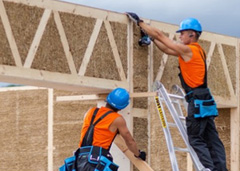
Straw panels, the convenience of LEGO with the charm of a country
cottage.
|
|
| |
|
|
|
|
|
| |
|
Straw panel technology provides
both a frame load-bearing construction element and, at
the same time, the main insulation for the building. A minimum
of wood is used to achieve a construction that is cost
effective and with no thermal bridges; the heat gaps in a
building. |
|
|
| |
Step by step building of a straw
panel home: see video button above
 |
|
|
|
|
|
|
|
|
Use less clay to plaster your straw walls
The clay plaster can be applied directly on the
inner straw surface and lime plaster on the exterior. Because the straw is
cut very accurately the
smooth walls use about half as much plaster for
this type of panel compared to straw bale building. The straw is
compressed while constructing the panels giving a
homogenous multidirectional structure gives good thermal resistance.
|
|
| |
|
 |
|
|
|
Build faster with straw panelsA particular advantage of
straw panels is their
speed of installation on the construction site. Depending on the
level of preparation, about 100 m2 of wall area can be
installed by four people within 1-2 days. The design of Ecococon's straw panels means they can be connected without the
use of special machines or tools, only a winch. Smaller panels
that are not too heavy can be moved by hand.
|
|
 |
|
| |
|
|
|
|
|
|
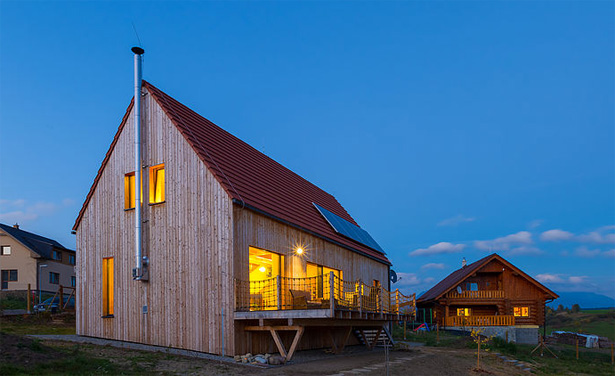
For an average home the super-insulating walls
could save around 4,000kWh of energy per year, a saving in the
region of £500 per year. Structural integrity of the panels is achieved by the integrated
wooden construction and can be easily calculated by your
structural engineer. The compressed but flexible straw can take
high loads in extreme cases, such as earthquakes, without losing
its integrity. |
|