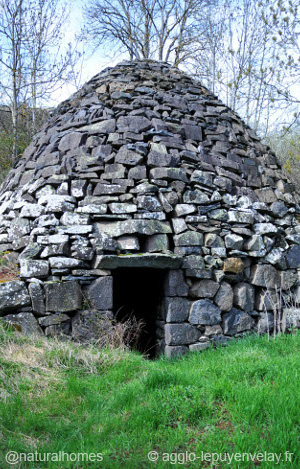
Traditional dry stone hut in the Haute-Loire, France.


This is a newly built dry stone hut, a traditional structure in the Haute-Loire, France called a chibotte. It is built using a technique known in French as 'des deux peaux' (two skins). Internally, there is a corbelled vault of flat stones inclined at an angle of about 15° in a vertical succession of rings of decreasing diameter. Externally facing stones are arranged with an inclination inwards to prevent them from slipping.


The construction of the vault is done layer by layer, rather than building the roof first and then the outer skin. This chibotte is by Manuel Duveau. It was built on the slopes of Aiguilhe in the spring of 2005 and took about 2 months to complete. Chibotte were built as temporary or seasonal shelters for workers in the fields and vineyards. The name chibotte was popularized in the early twentieth century by the scholar Albert Boudon-Lashermes, borrowed from medieval texts. The vernacular name used by winemakers was tsabone. Below are two older Chibotte from Puy-en-Velay in the heart of Haute-Loire.


Share your thoughts with your friends...


  More natural homes to enjoy...