Heidi's Natural Home in Southern Finland.
|
|
| |
|
|
|
|
|
| |
|
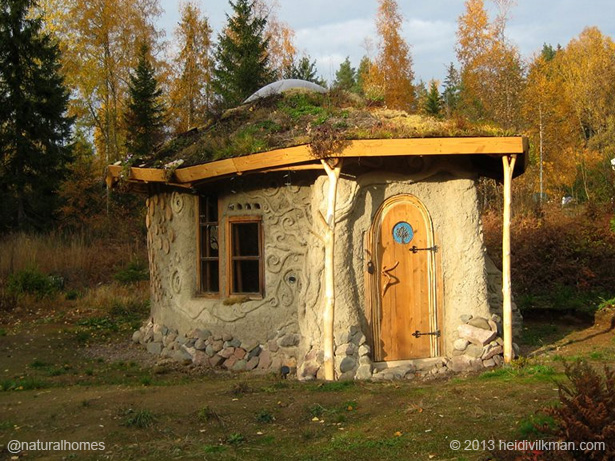
This is
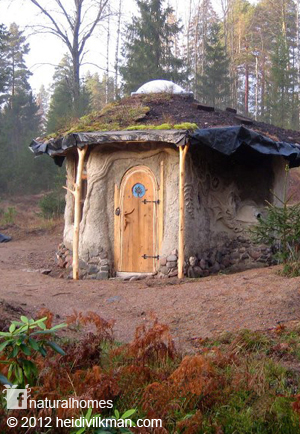
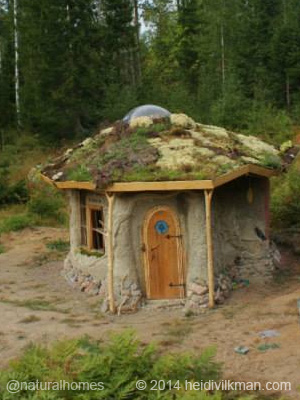
Heidi's cottage, 'Elaman Puu', which means Tree of Life. It's
built with a variety of natural building techniques with a rubble
trench, earthbag stem walls dressed in stone, birch bark
damp-proof membrane beneath the straw bales on the northern walls
with cob and cordwood to the south and a reciprocal
roof on a roundwood frame. All of the materials were harvested
locally.
|
|
|
 |
|
|
|
|
|
|
|
|
|
Heidi began her natural building journey by
investigating what natural materials were available on the land where she wanted
to build her tiny house. Set in the forests of southern Finland the choice of
roundwood timbers with a reciprocal roof was easy and obvious. Heidi
also dug several pits on the land to search out the clay she would later use to
plaster the interior of the home. Heidi is an accomplished artist. Having a
place that reflected her spirit and values was
important to her. With the materials she had decided to use in mind, she
started to design her home giving it all the care and attention
she gives the art she creates for her customers which you can see
below from her online shop. |
| |
|
|
| |
Heidi's Clay Model |
|
|
|
|
|
|
|
|
|
|
|
|
|
|
|
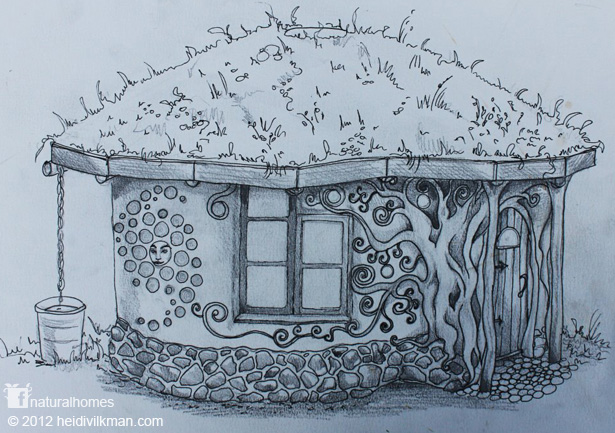
Below is one of the many sketches Heidi made to
visualise the place she wanted to build for herself and her son.
Eventually she used clay to create a model of the home (video
above right) |
|
|
|
|
|
|
|
|
|
|
|
 |
|
|
|
 |
|
 |
|
| |
|
|
|
|
|
 |
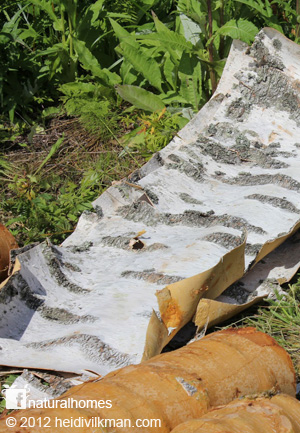
Birch bark for the damp proof course |
|
|
|
|
| |
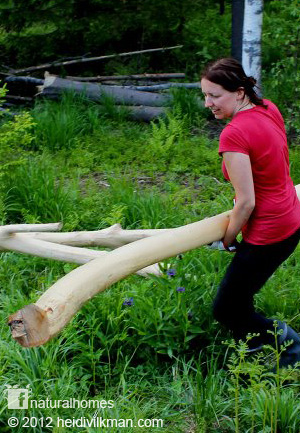
Roundwood for the reciprocal roof |
|
|
 |
|
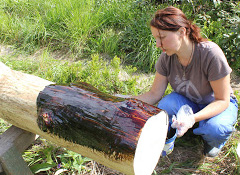
Heidi didn't want to pour concrete on what she sees as her
sacred space where she grew up as a child. She tarred the heavy logs for the cabin
and stood them onto a compacted
gravel base. More gravel was spread over the base and compacted,
burying and securing the logs.
| |
 |
|
| |
Heidi tarring the logs to protect against water |
|
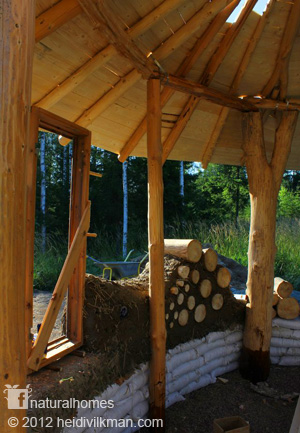
An earthbag stem wall was then built around the timbers of the
roundhouse with a layer of birch bark acting as a waterproof
membrane between the earthbags and the straw bale, cob
and cordwood walls. Heidi then dressed the earthbag stem wall with
stones to act as protection from rain splashing against the house. |
|
 |
|
|
|
|
|
|
|
|
| |
Earthbag and cordwood walls |
|
|
|
|
| |
The
dragon sleeping by the cob oven |
|
|
 |
|
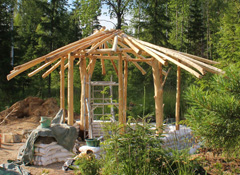
The roof of 'Elaman Puu' is made from a ring of roundwood
timbers interlocking and supporting one another. This self
supporting roof is called a reciprocal roof. The design leaves a
circular hole in the roof that forms a skylight bringing light
directly into the heart of Heidi's natural home.
| |
 |
|
| |
The roundwood reciprocal roof |
|
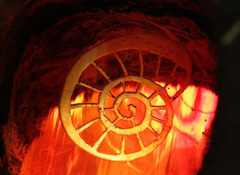
The home is festooned with artistic expression, a dance between
natural building techniques like cordwood, natural round timbers,
clay pargeting and Heidi's own artwork, like this beautiful
coloured etched glass window. |
|
 |
|
|
|
|
|
|
|
|
|
|
|
|
|
|
|
 |
|
There are still plenty of jobs to do before the tiny home is
complete. You can follow Heidi's story in her
blog and
facebook group as she continues to work on 'Elaman Puu'.
When Heidi is not building her home she runs
Heidi Made selling a wonderful mixture of her art, jewellery,
wood carvings and ceramics.
| |
 |
|
| |
Heidi's own etched glass design |
|
|
|
 |
|


