|
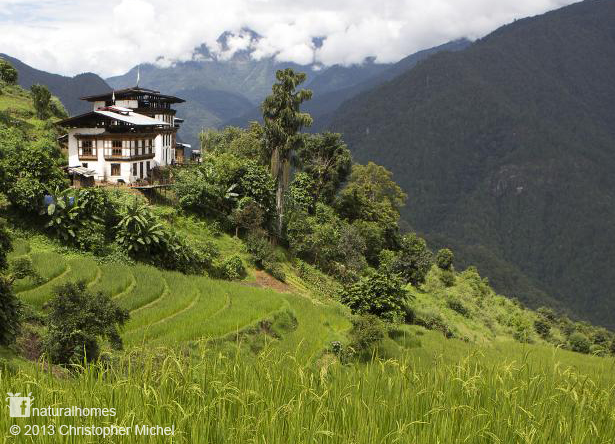
The windows and doors of the house are painted
with motifs of flowers and animals as decorations. This is one of
the patterns, No.
249, Ornament, recommended by
Alexander. It makes a connection between the elements of the
building and the life around them. |
|
|
Dzongs (below), are fortress castles that dominate the
landscape in every valley. They are constructed without
architectural plans under the direction of a high lama. Dzongs are
built with stone curtain walls surrounding one or more courtyards.
The main internal structures are built with stone or rammed earth, whitewashed inside and out with a
red ochre band at the top on the outside. The roofs are
massively constructed in hardwood and bamboo, highly decorated at
the eaves, and built without nails. Like the homes of Bhutan they are open at the eaves to
provide a ventilated storage area. |
|
Bhutan has a completely different approach to
prosperity from the rest of the western world. The Prime Minister
of Bhutan, Jigme
Thinley said, "The dogma of limitless productivity and growth in a finite world
is unsustainable and unfair for future generations". At the
International Federation of Organic Agriculture Movements he
made a commitment to sustainable agriculture saying, "...my government has pledged
to become 100% organic in food production…"
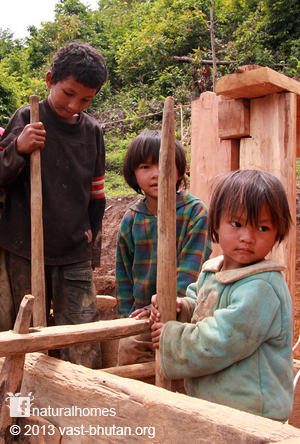
Below kids helping to build the family rammed earth home, a
Vast Bhutan project. |
|
Bhutan is the only nation in the world that
measures
Gross
National Happiness (GNH) while all
other nations focus on Gross Domestic Product (GDP). GNH was
launched formally in 1972 as an economic alternative to GDP.
| |
|
|
| |
Gross National
Happines |
|
|
|
|
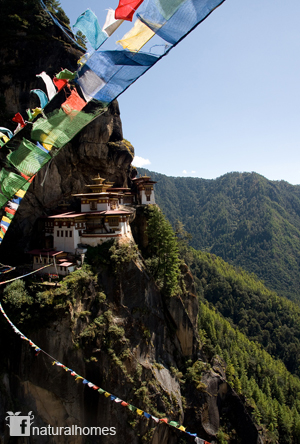
Taktsang Palphug Monastery,
Bhutan |
|
Rammed Earth Building
a
vast-bhutan project |
|
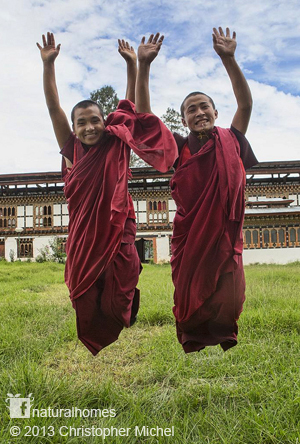
Bhutanese Monks,
photo by Christopher Michel |
|


%20while%20all%20other%20nations%20focus%20on%20Gross%20Domestic%20Product%20(GDP).%20GNH%20was%20launched%20formally%20in%201972%20as%20an%20economic%20alternative%20to%20GDP.%20Find%20out%20more%20at%20www.naturalhomes.org)

%20while%20all%20other%20nations%20focus%20on%20Gross%20Domestic%20Product%20(GDP).%20GNH%20was%20launched%20formally%20in%201972%20as%20an%20economic%20alternative%20to%20GDP.%20Find%20out%20more%20at%20www.naturalhomes.org)
%20while%20all%20other%20nations%20focus%20on%20Gross%20Domestic%20Product%20(GDP).%20GNH%20was%20launched%20formally%20in%201972%20as%20an%20economic%20alternative%20to%20GDP.%20Find%20out%20more%20at%20www.naturalhomes.org)
%20while%20all%20other%20nations%20focus%20on%20Gross%20Domestic%20Product%20(GDP).%20GNH%20was%20launched%20formally%20in%201972%20as%20an%20economic%20alternative%20to%20GDP.%20Find%20out%20more%20at%20www.naturalhomes.org)